The Finance Act for 2024 institutes a series of tax changes for companies and individuals. We present the main measures applicable

For companies
Electronic invoicing: new deployment schedule
A press release dated July 28, 2023 announced the postponement of the general introduction of electronic invoicing and the transmission of transaction data (e-invoicing and e-reporting), without however specifying a timetable.
The Finance Act for 2024 defines the new timetable as follows:
- Large and mid-sized companies will be required to issue electronic invoices from September 1, 2026;
- All companies must be able to receive electronic invoices by September1, 2026;
- Small and medium-sized enterprises and micro-businesses will be required to issue electronic invoices from September 1, 2027.
In both cases, given what is at stake for companies, the implementation dates may be adjusted by one quarter, to ensure reliable deployment.
All companies, including SMEs and VSEs, will eventually have to be able to receive and issue invoices in electronic format.
Phasing out the CVAE
The maximum CVAE tax rate, set at 0.375% for CVAE due in 2023, is gradually reduced to 0.28% for CVAE due in 2024, then to 0.19% for CVAE due in 2025 and to 0.09% for CVAE due in 2026.
Details :
- For companies with sales of less than €500,000, the tax rate is zero;
- For companies with sales of at least €500,000 but no more than €50 million, the tax rate varies according to sales.
Unchanged for the calculation of the CVAE 2023 balance to be settled in May 2024 (CVAE 2023 column), the new rates are as follows(CVAE 2024, 2025 and 2026 columns).

Adjustment of the system in favor of innovation
As a reminder, young innovative companies (JEI), whose conditions are set out in article 44 sexies 0-A of the French General Tax Code (CGI), benefit from preferential tax and social security treatment, in particular exemption from corporate income tax, initially in full for the first financial year, then in part for the following year, This is subject to certain conditions relating to the size of the company, its age, the composition of its capital and its newness, and also to the condition that research expenditure for the year represents at least 15% of tax-deductible expenses for that year.
The income tax exemption for JEI has been abolished for companies created on or after January1, 2024, although the exemption from social security contributions has been maintained for an unlimited period for the same JEI, as have the exemptions from CFE and property tax on built-up properties, subject to local authority approval, for companies created up to December 31, 2025.
In addition, JEI status has been extended to a new category of company, the young growth company (JEC), which spends between 5% and 15% of costs on research and development, but meets certain conditions to qualify as a company with high growth potential(these conditions will be set by decree).
Furnished rentals: details
Reminder of the system in place until 12/31/2023
Choice between two tax systems :
- Micro-BIC: allowing a flat-rate allowance:
- Of 71% for furnished tourist accommodation (requiring prior declaration to the Town Hall);
- Of 50% for other furnished rentals. - BIC au réel: allowing the property to be broken down and depreciation to be deducted, while retaining the capital gains tax regime applicable to private individuals in the event of disposal.
It should be noted that the threshold for the micro-BIC scheme was indexed to the threshold applicable to "trading activities and the provision of accommodation". The latter was €188,700.
New system introduced in LF 2024
As a preamble, the provisions contained in the LF 2024 on furnished rentals are applicable from 2023 income.

What should be done for 2023 income?
Wait... and subject to express confirmation to this effect, apply the existing provisions prior to the 2024 Finance Act.
For private customers
Revaluation of the income tax scale
For taxation of 2023 income, the limits of the brackets on the income tax scale have been raised by the average increase in consumer prices (excluding tobacco) expected for 2023, i.e. 4.80%.
The tax scale is as follows:

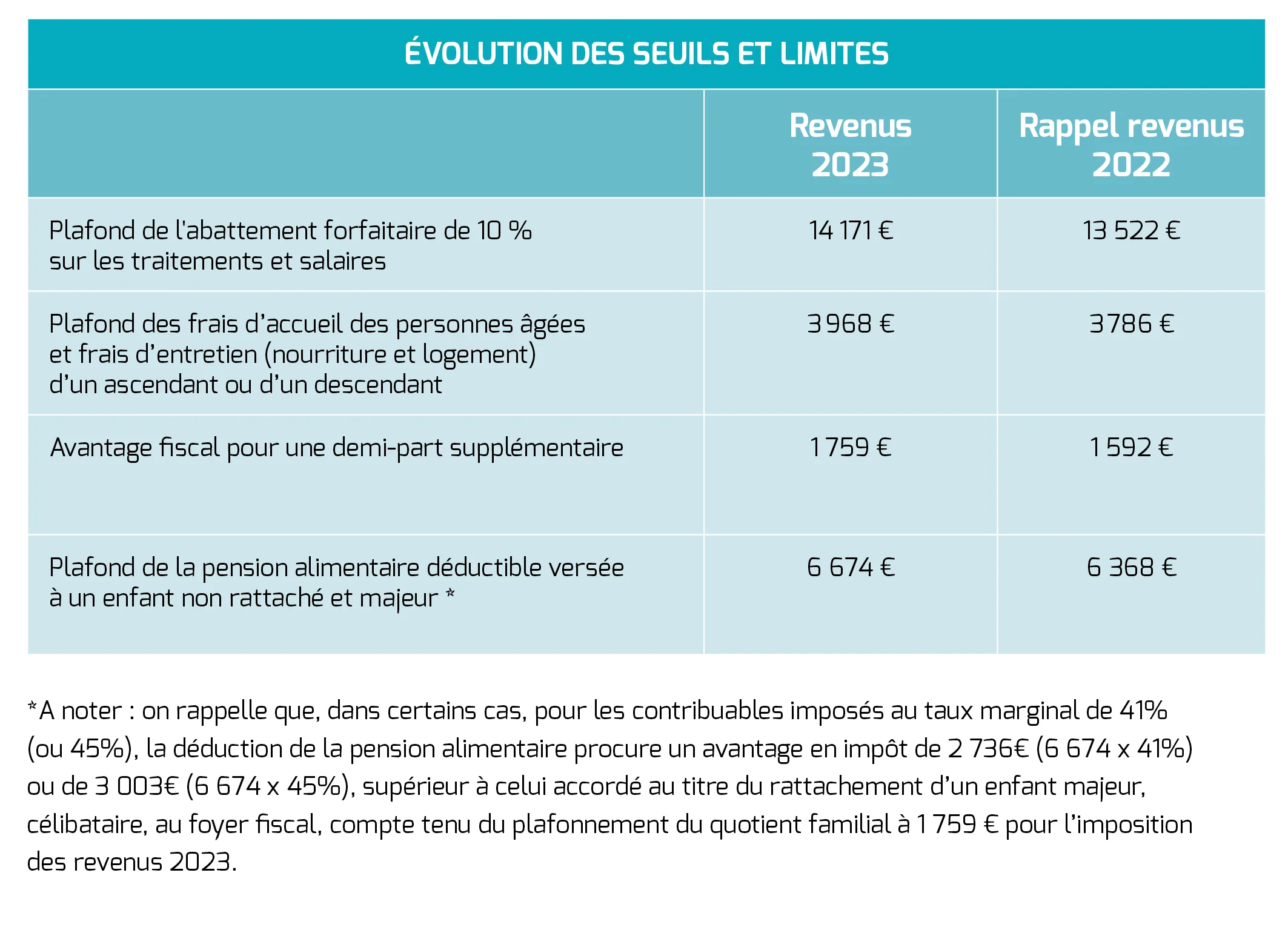
Revaluation of thresholds, ceilings or allowances
Adjustment of the PAS rate for couples subject to joint taxation
In principle, the withholding tax rate for couples subject to joint taxation is by default a common rate, which can be individualized by option. This principle will eventually be reversed: the individualized rate will be applied by default, while allowing taxpayers to opt for a common rate for the tax household. This measure will come into force on September1, 2025.
New savings plan: Plan Epargne Avenir Climat (PEAC)
The PEAC enables young people under the age of 21 to build up savings geared towards financing the ecological transition, and companies based in France or another EU country.
Subscribed in the form of a securities account combined with a cash account or a capitalization contract, the PEAC can receive cash deposits from the moment it is opened, up to an overall ceiling subsequently set by decree.
The arrival of the PEAC puts an end to the possibility of parents opening a retirement savings plan (PER) for their minor children. For PERs opened on or after January1, 2024, the holder must be at least 18 years old when the plan is opened.
Subscription to the capital of an SME: extension of the scope of application
Amounts paid to subscribe in cash to the capital of SMEs are eligible, under certain conditions, for a reduction in income tax (IR), known as the " Madelin law ".
The 18% rate will no longer be raised to 25% as was the case for 2022 and 2023, in favor of companies outside the JEI and JEC perimeter.
New features. The "Madelin tax reduction" also applies to payments made in respect of cash subscriptions made between January1, 2024 and December 31, 2028 to the capital :
- Companies which, at the date of subscription, qualify as young innovative companies (JEI) or young growth companies (JEC);
- Holding companies that subscribe to the capital of JEI or JEC.
This rate is raised to 30% when the payments made by the taxpayer are for the purpose of subscribing in cash to the capital of a JEI or JEC, all other conditions being met. This rate can be increased to 50% when the company's research expenditure exceeds 30%. The ceilings are €75,000 for the 30% rate and €50,000 for the 50% rate for a single taxpayer.
Tax credit for electric vehicle charging systems
Taxpayers resident in France for tax purposes can, under certain conditions, claim a tax credit for the purchase and installation of charging systems for electric vehicles, for expenses actually incurred between January1, 2021 and December 31, 2025.
This tax credit applies at a rate of 75%.
The ceiling on the tax advantage has been raised from €300 to €500, per load system.