1- 2024 value-sharing bonus: two possible payments, yes, but how?
While employers may now award two PPVs per year, they must conclude an agreement or formalize their decision for each bonus.
Three improvements have been made to the legal and regulatory framework for the value-sharing premium (VSP):
- SinceDecember 1,2023, the value-sharing bonus can be paid twice, in respect of the same calendar year, within the overall limit of the exemption ceiling (3,000 or 6,000 euros depending on the case) and the number of payments (i.e. four quarterly payments).
However, the award of two bonuses is possible "within the limit of one payment per quarter of each year": it does not therefore seem possible to make a quarterly payment for each bonus (only one payment per quarter is authorized); and :
- Maintenance of the current preferential social and tax regime for employees whose remuneration over the last 12 months is less than 3 times the annual minimum wage (Smic) in companies with fewer than 50 employees;
- Allowing the PPV to be invested in an employee savings plan or retirement savings plan, and exempting the amount invested from income tax when it does not qualify for tax exemption. Amounts invested in this way will be exempt from income tax, regardless of the amount of the employee's remuneration or the size of the employer's workforce. However, this exemption still applies up to a limit of €3,000 or €6,000 per calendar year and per employee.
Temporary tax exemption for companies with fewer than 50 employees: the company's headcount is the "social security" headcount, with no moratorium. It also clarifies the assessment of the headcount threshold to benefit from the tax exemption open to companies with fewer than 50 employees until 2026.
Please note! Threshold neutralization rules do not apply. Thus, employees of a company with 49 employees in 2022 and 52 employees in 2023 will not be able to claim the above-mentioned tax exemption on their value-sharing bonus (unless they allocate it to an employee savings or retirement plan).

2- When an employee on a fixed-term contract refuses an open-ended contract: new obligations for employers as of January1, 2024
A new procedure applies to employers who offer a permanent contract (CDI) to an employee who has already joined the company on a fixed-term contract (CDD). Employers are required to:
- expressly formalize the proposal of an open-ended contract to the employee prior to the end of the fixed-term contract. The Decree of December 28, 2023 sets out the procedure to be followed by the employer (C. trav., art. R.1243-11-1 (for fixed-term contracts) and R. 1251-11-1 (for temporary employment contracts).
- send France Travail (formerly Pôle Emploi) the information in the event of the employee's refusal to accept the offer of a permanent contract, or in the absence of a response within the allotted timeframe (decree of January 3, 2024 published in the JO on January 10, 2024 sets out the formalities). The employer must complete the form via the dedicated platform www.demarches-simplifiees.fr/commencer/refus-de-cdi-informer-francetravail within one month of the employee's refusal.
Under the terms of this decree, employers are required to inform France Travail using a form, via a dedicated platform that can be consulted on the organization's website. The text also states that this platform can be accessed at the following address: www.demarches-simplifiees.fr/commencer/refus-de-cdi-informer-francetravail.
If an employee refuses an offer of an open-ended contract that is identical to the initial fixed-term contract, he or she runs the risk of being deprived of unemployment insurance benefits if it is found that the employee refused the offer twice in the previous 12 months.
3- The "full-employment" law of December 18, 2023 - France Travail
Pôle emploi becomes France Travail
On January1, 2024, Pôle emploi became France Travail. This transformation is accompanied by the construction of a network for employment.
This network brings together the France Travail operator, the State, local authorities, local missions and Cap Emploi, who will share a common information system.
Unemployment compensation rules are maintained until June 30, 2024.
4- Exceptional aid extended to 2024
The exceptional aid paid to employers of apprentices and employees on professionalization contracts has been extended until December 31, 2024. It supplements the one-off apprenticeship grant to cover all levels of training, up to bac + 5.
As a reminder, this aid is granted for the first year of the contract and amounts to €6,000.
Aid is granted for the first year of performance of an apprenticeship contract signed :
- by a company with fewer than 250 employees to prepare for a diploma or professional qualification equivalent (bac + 2) to (bac + 5) in the national framework of professional certifications (CNCP);
- by a company with 250 or more employees to prepare for a vocational diploma or qualification equivalent to CNCP level 7 (bac + 5) or higher.
Aid is also granted for the first year of a professionalization contract signed with a young person under 30 years of age on the date the contract is signed and preparing :
- a diploma or professional qualification equivalent to (bac + 5) from the CNCP ;
- a professional qualification registered in the National Vocational Certification Directory, recognized in the classifications of a national industry collective agreement, or giving entitlement to an industry or inter-industry professional qualification certificate.
To qualify, companies with at least 250 employees must have a minimum percentage of work-study students in their workforce by December 31 "of the year following that in which the apprenticeship contract or professionalization contract is signed" (in concrete terms, December 31, 2025 for those hired in 2024).
Employers with at least 250 employees must, within 8 months of signing the contract, send the Agence de service et de paiement (ASP) an undertaking certifying on their honor that they will meet the obligations set out in the contract. By May 31 2026 at the latest, they must send a declaration on their honor attesting to compliance with their commitments.
5- LFSS 2024: Foreign companies can no longer appoint a third party to represent them
With the introduction of the electronic one-stop shop, the legislator has removed the option for foreign companies to use a representative to carry out their declaratory formalities.
Employers with no establishment in France are required to comply with all formalities relating to the employment of employees covered by the French Social Security system, regardless of the nature of their business or their legal form.
At present, the employers concerned can either complete the formalities directly or appoint a representative resident in France, who is personally responsible for filing the declarations and paying the amounts due (CSS, art. L. 243-1-2).
Article 13 of the Social Security Financing Act for 2024 removes this option.
From March1, 2024, foreign companies will no longer be able to delegate responsibility for their social security declarations to an employee or third party resident in France. They will have to register with the "guichet unique des formalités des entreprises" to comply with their social obligations.
6- Evidence obtained unfairly is admissible under certain conditions, except in the case of elements relating to the employee's private life.
The decision of the plenary assembly of the French Supreme Court (Cour de cassation) Dec. 22, 2023, no. 20-20.648:"In civil proceedings, the unlawfulness or unfairness of obtaining or producing evidence does not necessarily lead to its exclusion from the proceedings. The judge must, when requested to do so, assess whether such evidence undermines the fairness of the proceedings as a whole, by weighing up the right to evidence against the conflicting rights at stake, the right to evidence being able to justify the production of elements infringing other rights, provided that such production is essential to its exercise and that the infringement is strictly proportionate to the aim pursued".
7- Revaluation of the SMIC
On January1, 2024, the minimum growth wage in France was revalued by 1.13%. As a result, the gross hourly minimum wage rises to 11.65 euros, or 1,766.92 euros per month for full-time work. The exception is Mayotte, where it has been raised to 8.80 euros, or 1,334.67 euros per month.
8- The waiting period for IJSS benefits in the event of miscarriage will be abolished on January1, 2024
Act no. 2023-567 of July 7, 2023 introduced a new provision whereby daily social security benefits (IJSS) would be paid immediately in the event of incapacity for work following a spontaneous termination of pregnancy before the 22nd week of amenorrhea. Compensation by the health insurance scheme would therefore be paid from the1st day of interruption.
In the absence of a decree, it came into force for work stoppages prescribed from January1, 2024.
9- Increase in trainee bonuses in 2024
Due to the revaluation of the social security ceiling, the minimum amount of gratuity paid to trainees for an internship lasting more than two months has been increased as of January 1, 2024. Unless there is a more favorable collective agreement, it will be set at 4.35 euros per hour instead of 4.05.
If the duration of an internship with the same company exceeds two months, consecutive or otherwise, during the same school or university year, the intern receives a bonus (C. éducation, art. L. 124-6).
Amounts paid to interns that do not exceed this minimum gratuity are not considered as remuneration, and are therefore not subject to social security contributions.
10- Home-work transport costs
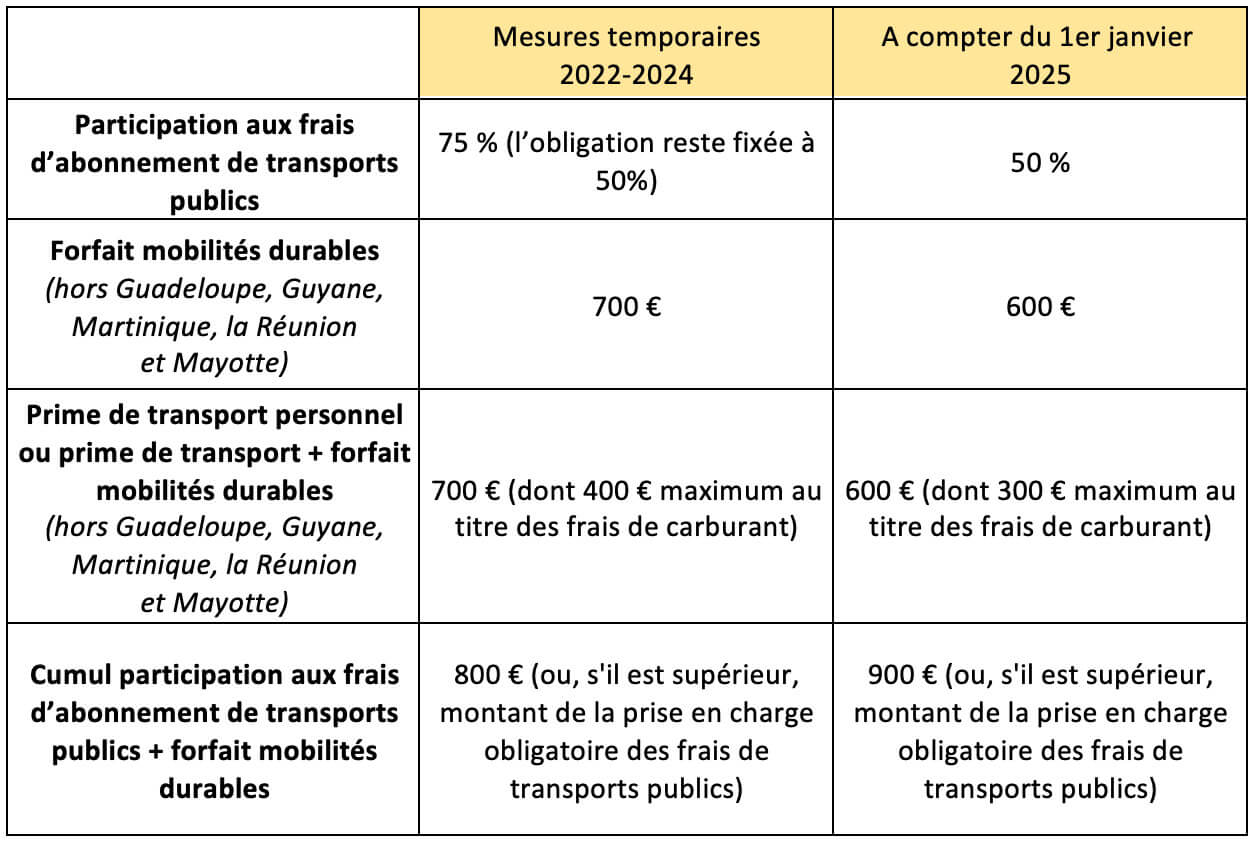
The income tax and social security contribution exemption ceilings applicable to employee commuting expenses paid by employers in 2022 and 2023 are renewed in 2024.
- Employers can (or must) cover all or part of their employees' travel costs to and from work via the optional transport bonus, which covers fuel and power costs for electric, plug-in hybrid or hydrogen vehicles;
- The sustainable mobility package, also optional, which covers the cost of journeys made using "clean" forms of transport (bicycles, car-sharing, electric scooters, etc.);
- A mandatory 50% contribution to the cost of public transport passes (bus, train, metro, etc.) and public bicycle rental services;
- When the coverage is optional, this possibility is subject to compliance with certain conditions in order to be treated as a business expense, and must be applied to all employees.
11- Measures extended to 2024:
- exemption from the "transport bonus" (personal vehicle fuel costs), even if the employee has the option of using public transport for his or her journeys;
- possibility of covering both public transport costs and personal vehicle fuel costs for the same employee, contrary to the original rule;
- increase in exemption thresholds for public and personal transport costs;
- Legal thresholds for exemption from contributions, CSG/CRDS and income tax: