CSRDapplicable since 1er January 2024, which is covered by the European directive on reporting reporting directive?
The development of European legislation on corporate social and environmental responsibility has taken another significant step forward with the entry into forceinto force oner January 2024, of the Corporate Sustainability Reporting Directive (CSRD). This directive represents a major evolution of the previous Non-Financial Reporting Directive (NFRD), aimed at enhancing transparency and moving business models towards greater sustainability.
This ambitious directive represents a tool regulatory tool regulatory tool to support the ambition of ecological ecological transition and equity of the European Union. By strengthening disclosure of extra-findisclosure, it aims to redirecting capital towards an economy sustainable economyencourage companies to identify and reduce systemic risks, and strengthen the social contract between business and civil society . society.
But who exactly is affected by this directive?
The CSRD applies to small and medium-sized companies listed on EU regulated markets, as well as to large unlisted companies that meet certain defined criteria. These criteria include a specific number of employees (usually over 250) and a certain balance sheet threshold (usually over €25 million) or sales threshold (€50 million).
In addition to companies, CSRD also concerns certain financial institutions such as banks, insurance companies and asset management companies. These entities are required to disclose non-financial information relevant to assessing their performance, particularly with regard to their social and environmental impact.
Companies that control other companies (parent companies) must publish consolidated non-financial information, covering not only their own activities, but also those of their subsidiaries.
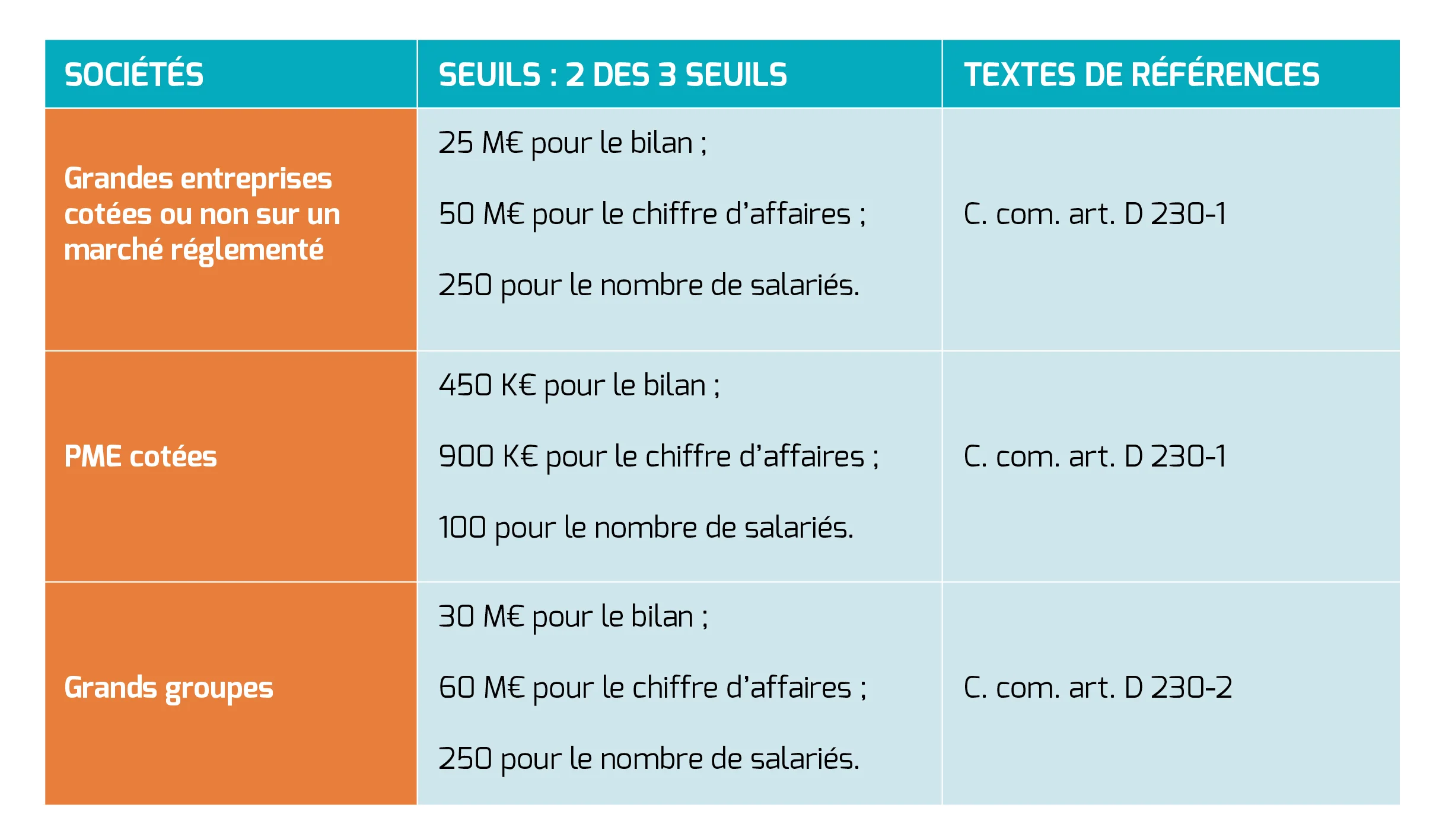
Summary table of thresholds
The CSRD will apply progressively from 2024 to companies that exceed two of the following three thresholds
The calendar
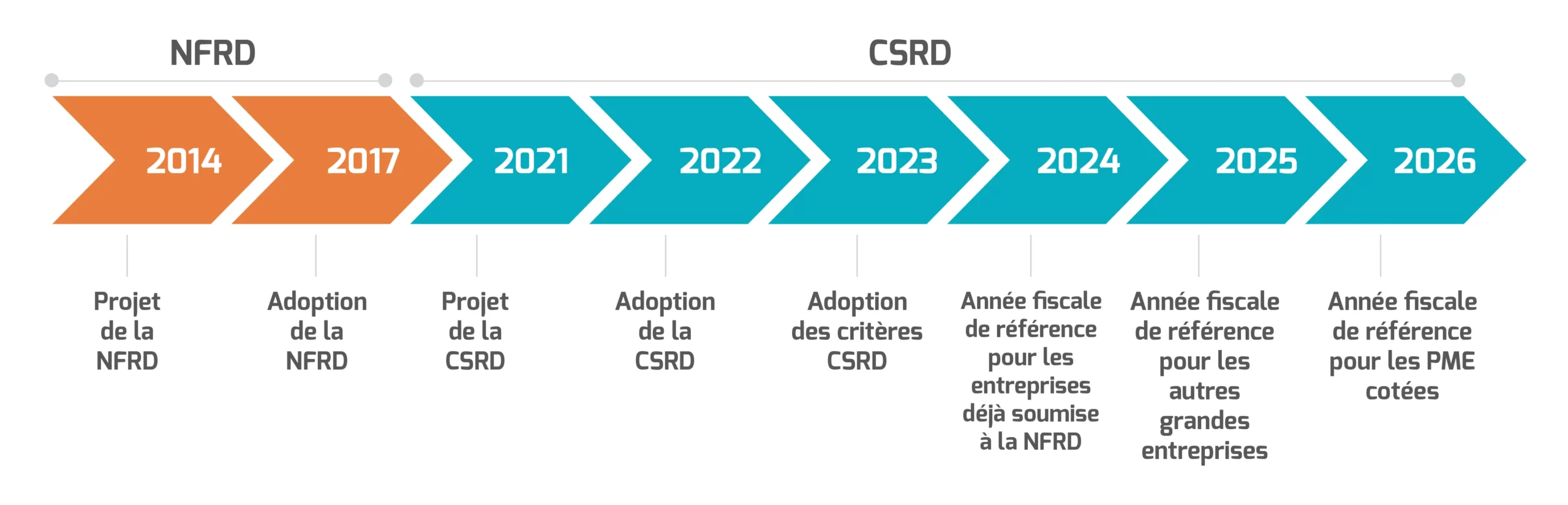
The European CSRD directive is applied in in 3 stages, depending on the company concerned:
From January 1, 2024: Publication of report in 2025
Large companies listed on a regulated market in the European Union, with more than 250 employees and a balance sheet or sales exceeding €25 million or €50 million respectively, must start preparing their sustainability reports for publication in 2025.
From 1st January 2025: Report published in 2026
All large companies, whatever their legal form, exceeding two of the following thresholds:
- total assets of over 25 million euros (30 million consolidated for groups)
- net sales in excess of 50 million euros (60 million consolidated for groups)
- more than 250 employees,
are required to publish their sustainability reports in 2026.
From 1st January 2026: Report published in 2027
Certain small and medium-sized companies meeting two of the following thresholds:
- total assets of between 0.45 and 25 million euros
- sales between 0.9 and 50 million euros
- 100 to 250 employees
must also publish their sustainability reports in 2027 if they are public-interest entities (listed on the stock exchange, credit institutions or insurance companies).
From 2028: Publication of report in 2029
Listed SMEs can benefit from a simplified reporting standard, and have the option of deferring publication until 2029.
CSRD aims to foster a more sustainable and responsible corporate culture by making non-financial information more accessible to investors, stakeholders and the general public. By identifying the companies concerned, it is possible to better understand who is accountable for their social, environmental and governance (ESG) impacts, and thus encourage more informed and responsible decision-making in the business world.
Information certification
The information provided by the company must be certified by a statutory auditor or an accredited independent third-party organization.
Legal texts and references
decree no. 2024-152 of February 28, 2024 modifying the sales and balance sheet thresholds defining the categories of companies and groups of companies.