An six fter six years of negotiations, the social partners in the metallurgy sector have concluded a new collective agreement. The aim of these negotiations was to objective harmonize and simplify the numerous existing collective bargaining agreements in the industry.
After the first stage, which covered provisions relating to supplementary social protection (provident schemes and healthcare costs) that came into force on January1, 2023, all collective bargaining provisions will apply from January1,2024.
The second and final stage of the new collective bargaining agreement for the metalworking industry will come into force in less than six months! So it's time to get to grips with the provisions of this collective agreement, so as to be ready for the January1,2024 deadline.
Thus, thenew collective agreement of February 7, 2022 replaces the existing 76 territorial collective agreements, as well as the collective agreements for engineers and managers in the metallurgy and steel industries. Many new features apply. The main changes are as follows:
- A new, single national pay scale;
- A new method for calculating seniority bonuses ;
- The possibility of using fixed-hour or fixed-day contracts for executives and non-executives alike;
- Review of exceptional leave for family events ;
- New provisions on part-time work ;
- And finally, with an unavoidable impact on your company and without a transposition gridA new classification grid based on a six-criteria job rating system.
This change creates a new task for the employer, who must draw up job descriptions in the company (please note that these relate strictly to jobs - the skills of the employees assigned to the job are not taken into consideration when drawing up these files)..
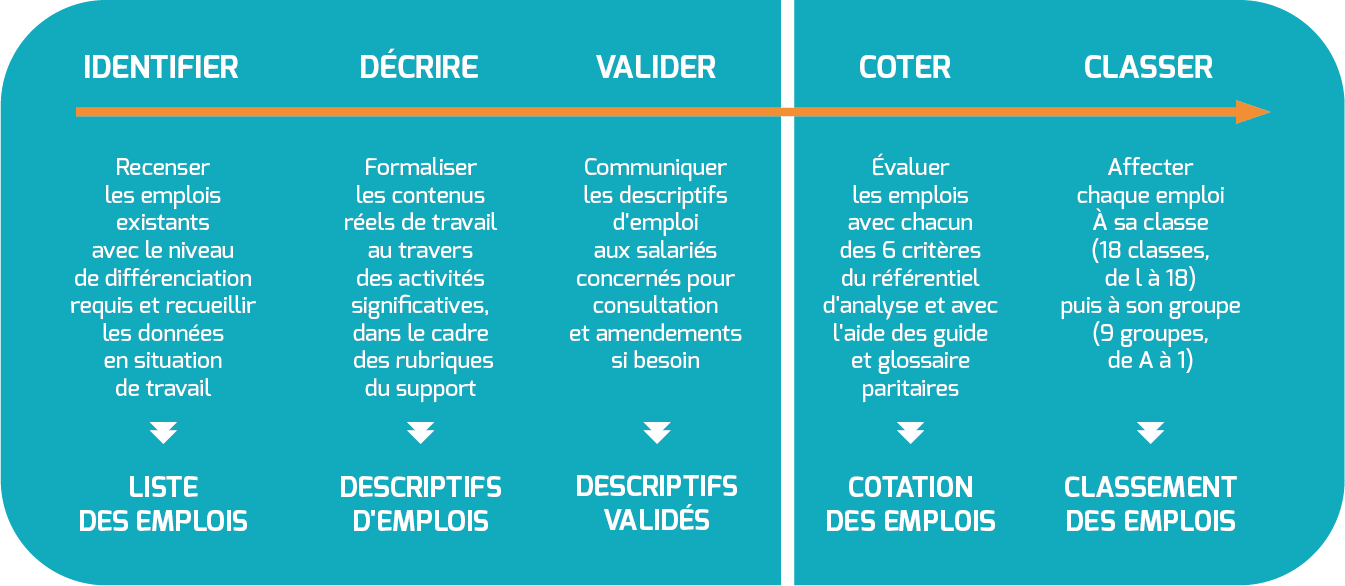
Your actions are summarized below. An educational guide has been drawn up for the implementation of this new classification grid.
The approach is based on an actual analysis of the job which must be carried out using six classifying criteria:
- The complexity of the business,
- Knowledge,
- Autonomy,
- The contribution,
- Framing and cooperation,
- Communication.
These classification criteria are common to all jobs, in order to take into account the diversity of industrial company activities.
Ten degrees correspond to each criterion. The degrees are added together to produce a rating. The least qualified job is rated at 6, and the most qualified at 60. The position in the classification grid corresponds to a hierarchical minimum wage.
Our labor law department is at your disposal for any further information you may require and/or to help you implement the new provisions of the agreement.