
This work consists of establishing a work program tailored to your to your specific needs and the requirements of the certification, whether DPEF or mission-based.

Independent Third-Party Verification (OTI)
Exco Fiduciaire du Sud-Ouest is accredited by COFRAC for the verification of the declaration concerning the fulfilment of social and environmental objectives by companies, mutuals and unions with a mission (accreditation N°3-2132 rev.0, scope available on www.cofrac.fr).
At Exco FSO, you'll benefit from :
A commitment to ecosystems
Exco FSO is a member of the Community of Mission Companies and participates in the Cercle des OTI, an ongoing working group of ITOs who share best practices to improve audit quality.
Sustainable know-how
Our pragmatic approach helps you secure your ESG data, based on robust methodologies and easy-to-use tools.
Benefit from the CSR expertise of auditors who are as close as possible to the realities and issues at stake, so that your audit is anchored in a path of progress.
Transparency and enhanced rendering
- appoint a team dedicated to the task in hand;
- to provide a single, permanently accessible point of contact within the firm;
- to ensure that teams working on projects have access to in-house monitoring and expertise units. All this in an Exco environment whose objective is to secure processes and implement best practices;
- that each assignment is presented in a personalized way, so that the work can be better understood.
Audit of mission companies
We verify the achievement of the social and environmental objectivesset out in your Articles of Association, and issue a reasoned opinion as to whether these objectives have been met.
Verification process
Our PROG 01 verification program (current version) is structured around 8 main phases :
Our commitment to impartiality
In order to carry out our verification activities with complete impartiality, we rely on specific systems guided by the requirements of the law and the ISO 17029 standard:
- guarantee our independence and objectivity,
- guarantee the confidentiality of information,
- guarantee the integrity of everyone involved in these activities.
These measures include a process for identifying potential conflicts of interest prior to acceptance of an audit engagement, and a risk analysis incorporating the impartiality risks that may impact the audit organization and the performance of its activities, with the aim of controlling the risks identified.
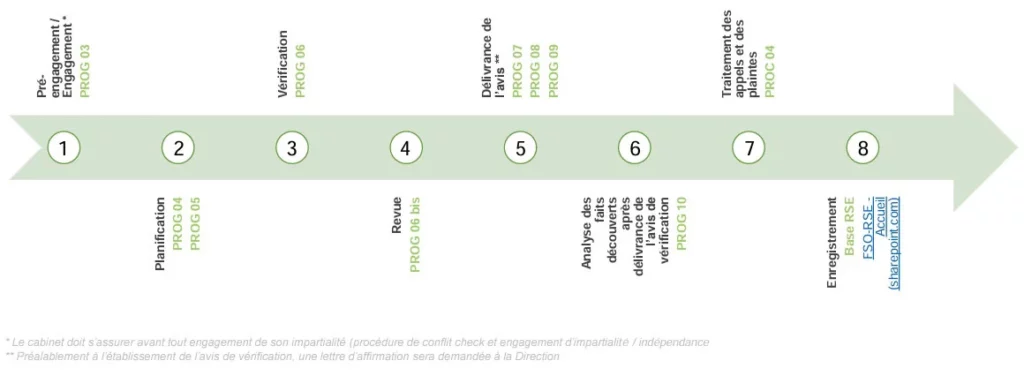
Phase 1: Pre-commitment and commitment work
This work consists of preliminary interviews getting to know the company, its business model, its social & environmental objectives, the organization of its reporting (definition, tools, scope, responsibility) and its indicators....
At the same time, a risk analysis is carried out at the same time, enabling an appropriate work program to be drawn up (see below).
This phase will end with a review of the work by one or more independent persons.
ISO standard 17029 requires that the opinion be issued by a person or persons who were not involved in the verification phase. In this case, they must first review the verification fileThey must then ensure that the verification has been carried out in accordance with the requirements of the work program and engagement letter, and that the evidence is sufficient and appropriate, and that any anomalies have been identified, resolved and documented.
They carry out the review, are responsible for formulating the opinion and may not delegate this task.
Phase 2: Planning
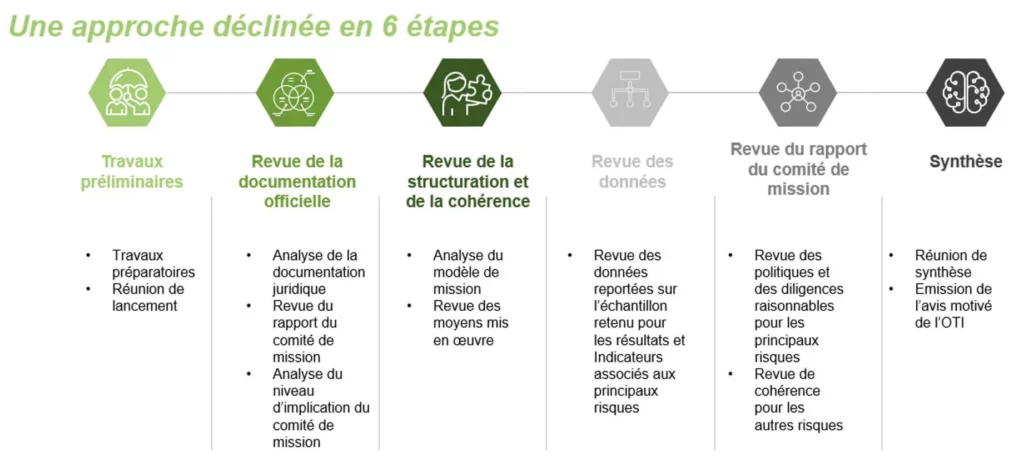
Phase 3: Verification
Our mission will be to verify that the social and environmental objectives that the company is committed to pursuing in the course of its business, and which it has enshrined in its articles of association.
- In order to do this, we will ascertain the existence of operational objectives and key indicators for monitoring and measuring their achievement by the company at the end of the period covered by the audit for each social and environmental objective,
- We will check whether the operational objectives have been achieved in relation to the trajectories established by the company for the scope of its "société à mission" status, as described in the report(s) of the "comité de mission".
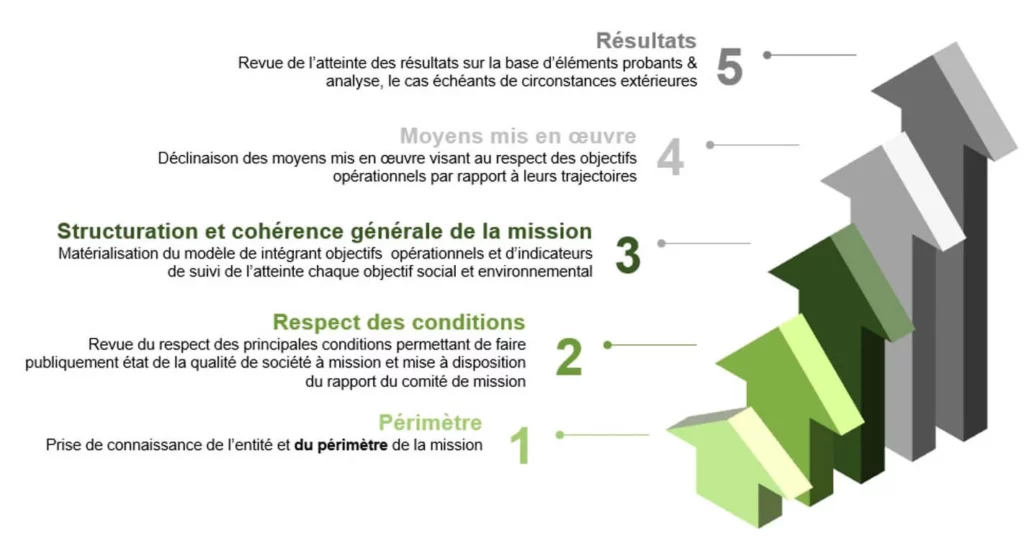
Phase 4: Review
This phase will end with a review of the work by one or more independent persons. ISO 17029 requires that the opinion be issued by a person or persons who were not involved in the verification phase.
In this case, they must first review the verification fileto ensure that the verification has been carried out in accordance with the requirements of the work program and the engagement letter, and that the evidence is sufficient, appropriate and that any anomalies have been identified, resolved and documented.
Phase 5: Issuance of verification notice
This phase consists of issuing our OTI report report in accordance with legal and regulatory requirements. It will be completed by the drafting of a summary enabling us to share with the entity's management a summary of our findings and conclusions
It contains at least the following elements:
- Summary of work performed and main conclusions ;
- Identification of strengths and areas of risk in the implementation of the mission.
Phase 6: Analysis of facts uncovered after issuance of the verification notice
If, after the date on which the reasoned opinion is issued, new information is obtained on facts that occurred during the the period covered by the auditlikely to materially affect the opinion issued, we :
- will inform the entity as soon as possible in order to assess whether these facts are likely to have an impact on compliance with social and environmental objectives;
- will take appropriate action, including discussing the situation with the entity and determining whether the reasoned opinion needs to be revised or withdrawn.
If the reasoned opinion requires revision, we will take the necessary steps to issue a new to issue a new opinion including the precise reasons for the revision.
Phase 7: Handling calls and complaints
We publish on our website the process by which it receives, evaluates and makes decisions in the event of appeals or complaints. This process ensures that the decision is reviewed and approved by people who were not involved in the decision being appealed or complained about, so as not to give rise to discriminatory actions.
Phase 8: Recording
Exco FSO keeps and manages records related to its verification activities, including:
- information submitted by the customer during pre-engagement and the scope of the audit
- justification of the verification method and duration
- any review of audit planning activities
- demonstration that verification activities have been carried out in accordance with the requirements of standard 17029 and the verification program
- evaluation, selection and monitoring of subcontractors
- evidence to support conclusions and decisions
- audit notices
- complaints and appeals, as well as any resulting corrections and corrective actions.
The recordings are stored on the online recording system, which guarantee the required confidentiality. In addition, access rights are granted to prevent unauthorized modification of documents.
These measures include a process for identifying potential conflicts of interest prior to acceptance of an audit engagement, as well as a risk analysis integrating the impartiality risks that could impact the verification body and the performance of its activities. The aim of this risk analysis is to control the risks identified.