What can employers do to increase their employees' purchasing power?
Increasing wages is not the only way to boost employees' purchasing power.
The employer has a number of other levers at his disposal, including :
LUNCHEON VOUCHERS
How it works :
- Implementation by DUE or collective agreement
- Employer contribution of 50% to 60% of the voucher's face value
- The full value of meal vouchers is paid by the employer, who then recovers the employee contribution either by payroll deduction, in cash or by cheque.
- Choice of paper or paperless meal vouchers
Advantages :
- For the company :
- Exemption from Social Security contributions, if the company's contribution remains within the limits imposed by law, i.e. €5.69 per share in 2022.
(ceiling raised to €5.92 per share for the period from 01.09.2022 to 31.12.2022)
- For the employee:
- Have a non-taxed additional income to finance meals
- In principle, meal vouchers can be used to pay for a directly consumable meal or food preparation, or for fruit and vegetables.
As an exception to these rules, the French "purchasing power" law allows meal vouchers to be used for any food product, whether directly consumable or not (e.g. oil, flour, etc.), until December 31, 2023.
Points to watch :
- For the company:
- The introduction of luncheon vouchers represents a cost...
- ...and management (with vacations, absences, employees on leave, part-time work)
- Part-time employees may find themselves excluded from the scheme if their working hours are not interspersed with a meal break.
- For the employee:
- Meal vouchers may be less advantageous than actual expense reimbursement for employees on business trips
- When filing his income tax return, the employee will no longer be able to deduct the cost of meals from his actual expenses.
- sometimes restrictive to use (max. 2 luncheon vouchers/day, only certain products eligible, no change on paper vouchers, etc.).
- Decrease in net pay (due to employee contribution) can be unpleasant
VACATION VOUCHERS
How it works :
- Vacation vouchers can be offered by the employer or by the CSE, with or without employer participation.
- They can benefit from different social security exemptions depending on whether the vacation vouchers are set up at the initiative of the CSE or the employer.
- They must be financed by both the employer (or works council) and the employee.
- They must be offered to all company employees, whatever the nature of their employment contract: permanent or fixed-term, full-time or part-time, sandwich course, etc.
- Employees can refuse to subscribe to vacation vouchers
- Vacation vouchers must not be substituted for any other form of remuneration
- The amount and terms of the employer's (or CSE's) and employee's contributions are determined according to :
o salary levels (the employer (or CSE) contribution must be higher for employees with the lowest incomes)
o on the basis of non-discriminatory criteria (single parents, number of children, etc.)
- The directors or managers of a company with fewer than 50 employees can themselves benefit from these shares.
Goal:
- Increase purchasing power for vacations and leisure activities (accommodation, travel and transport, leisure and culture, catering, sporting activities).
Maximum reimbursement of vacation vouchers :
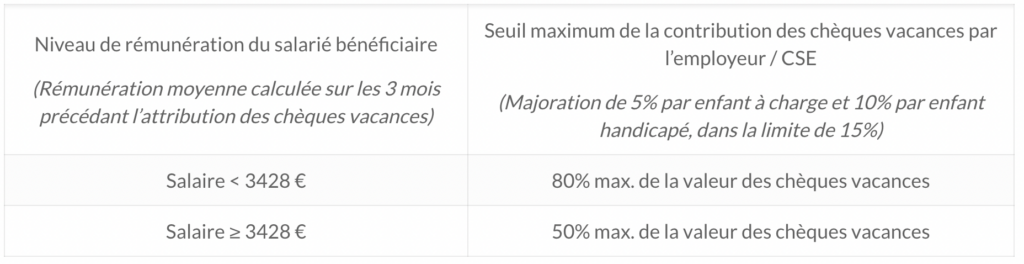
Overall annual ceiling :
The employer's total annual contribution may not exceed half the SMIC (at January1st ) multiplied by the number of employees in the company (whether or not they are vacation voucher beneficiaries).
Social and tax exemptions :
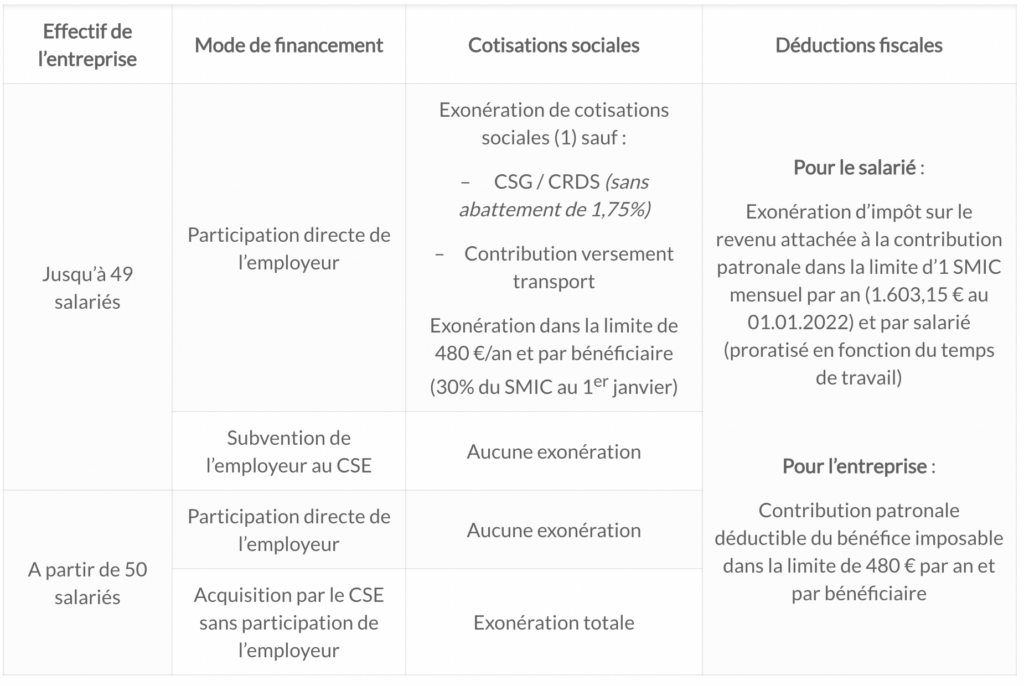
(1) In companies with fewer than 50 employees, the exemption is granted if the employer's contribution meets the following 3 conditions:
- be higher for the lowest-paid employees
- be the subject of either a collective agreement or an employer proposal submitted to all employees
- does not replace any element of salary paid or planned.
PROFIT-SHARING AND INCENTIVE SCHEMES
Participation :
- Optional for companies with fewer than 50 employees, but mandatory for those with 50 or more;
- allows employees to share in the company's results by allocating a portion of the profit earned;
- allows employees to build up savings with the help of their company;
- the employee may decide to receive the sums immediately (in which case they will be taxable) or to invest them in a plan (PEE, PERCO, etc.); they will be blocked for 5 years, except in the event of early withdrawal, and will not be taxable.
Profit-sharing :
- is optional for all companies;
- allows the company to make payments to employees based on the economic or financial performance (sales, profits, etc.) achieved over a year or a fraction thereof;
- the employee may decide to receive the sums immediately (in which case they will be taxable) or to place them in a savings plan. They will be blocked for 5 years, except in the event of early withdrawal, and will not be taxed;
Advantages of an employee savings plan :
- For the company :
- is an instrument for motivating employees and building loyalty;
- Social and tax benefits: profit-sharing and incentive payments :
- are not subject to social security contributions
- ni à forfait social dans les entreprises < à 50 salariés pour la participation, et dans celles < à 250 salariés pour l’intéressement
- Profit-sharing and incentive payments are deductible from company profits;
- For the employee:
- Top-up salary or savings ;
- Tax benefits: profit-sharing and incentive amounts invested in a savings plan are tax-deductible:
- non-taxable
- exempt from social security contributions
However, they are subject to CSG / CRDS.
- Employer contribution possible.
Setting up an incentive and/or profit-sharing supplement
- If the results of the last financial year allow it, the employer may pay a supplement, via a Unilateral Employer Decision, subject to :
- Whether the company already has a profit-sharing and/or incentive agreement;
- And that the distribution arrangements set out in the original agreement are respected.
TRANSPORT PREMIUM
- Can be awarded to employees who have to use their personal vehicle to get from home to work,
- Corresponds to the cost of fuel or power for an electric, plug-in hybrid or hydrogen vehicle.
- The amount, terms and criteria for reimbursing these expenses are determined by company agreement, failing which by industry agreement, or in the absence of agreement, by Unilateral Employer Decision, after consultation of the CSE, if any.
Employee conditions :
Employees are eligible for this coverage:
- whose habitual residence or place of work is located in a commune not served by a regular public transport service or a private service set up by the employer;
- for whom the use of a personal vehicle is essential due to special working hours (night work, staggered working hours, continuous work, substitute shifts, etc.).
- whose habitual residence or place of work is not included in the perimeter of a mandatory mobility plan (art. L.1214-3 and L.1214-24 of the French Transport Code);
However, in order to help employees cope with the sharp rise in fuel prices, the Supplementary Finance Act of August 16, 2022 abolished these conditions for the years 2022 and 2023. The transport bonus is thus open to all employees for travel between their usual place of residence and their place of work.
Exemptions :
The cost of fuel or power for electric, plug-in hybrid or hydrogen vehicles is exempt from all social security contributions, up to an annual limit of :
- 200 per employee for fuel costs
- 500 for powering electric, plug-in hybrid or hydrogen vehicles
However, in 2022 and 2023, the exemption from contributions is allowed up to a limit of €400 for fuel costs, and up to a limit of €700 for power supply costs for electric, plug-in hybrid or hydrogen vehicles.
What's more, in 2022 and 2023, the commuter bonus can be combined with the compulsory employer-paid public transport season ticket, which is normally impossible.
The employer must be able to produce a photocopy of the employee's vehicle registration certificate.
As of January 1, 2024, it will also have to be able to justify the reimbursement of expenses by having the necessary information collected from employees (residence outside a transport perimeter or essential use of personal vehicle).
PAYMENT OF MILEAGE ALLOWANCES FOR "HOME-WORK" JOURNEYS
- Can be awarded to employees who have to use their personal vehicle to get from home to work,
- Corresponds to the cost of fuel or power for an electric, plug-in hybrid or hydrogen vehicle.
- The terms and conditions (amount and allocation criteria) for the reimbursement of these expenses are determined by company agreement, failing which by industry agreement, or in the absence of an agreement, by unilateral decision of the employer, after consultation of the CSE, if there is one.
Employee conditions :
Employees are eligible for this coverage:
- whose habitual residence or place of work is located in a commune not served by a regular public transport service or a private service set up by the employer;
- for whom the use of a personal vehicle is essential due to special working hours (night work, staggered working hours, continuous work, substitute shifts, etc.).
- whose habitual residence or place of work is not included in the perimeter of a mandatory mobility plan (art. L.1214-3 and L.1214-24 of the French Transport Code);
Exemptions :
The amount excluded from the basis of assessment for contributions and levies resulting from the employer's payment of mileage allowances may not exceed the total amount of expenses actually incurred by the employee for journeys between his usual place of residence and his place of work.
The employer must be able to provide proof of :
- The means of transport used by the employee
- Distance between home and workplace
- The vehicle's tax rating
- The number of trips made each month
Points to watch :
- This service cannot be combined with actual expenses for tax purposes (when filing income tax returns).
- Not all employees are eligible.
SUSTAINABLE MOBILITY PACKAGE
- Optional device
- Covering the cost of employees' home-to-work journeys by bicycle, electric bike, carpool as driver or passenger, public transport or other shared mobility services.
- The terms and conditions (amount and allocation criteria) for the reimbursement of these expenses are determined by company agreement, failing which by industry agreement, or in the absence of an agreement, by unilateral decision of the employer, after consultation of the CSE, if there is one.
Eligible modes of transport :
- Bicycles and electric-assist bicycles (personal and rental) ;
- Carpooling (driver or passenger) ;
- Personal mobility equipment, mopeds and motorcycles for hire or self-service (such as free-floating scooters and electric scooters);
- Car-sharing with electric, plug-in hybrid or hydrogen vehicles;
- Public transport (excluding season tickets)
- Motorized personal mobility equipment (scooters, monoroues, gyropodes, skateboards, hoverboards, etc.).
When these machines are motorized, the motor or assistance system must be non-thermal.
Please note:
private scooters, walking, cabs (including bicycle cabs), VTCs and train season tickets are not currently eligible.
The amount of the Sustainable Mobility Package
Up to €500 per year per employee, tax and social security contributions are waived. Above €500, the additional amount is subject to tax and social security contributions.
However, in 2022 and 2023, the exemption from social security contributions is limited to €700 per year per employee.
In addition, the sustainable mobility package can be combined with :
- Transport allowance: in this case, for income tax purposes in 2022 and 2023, the law will raise the exemption ceiling to €700 per year (compared with €500 normally), including a maximum of €400 per year for fuel costs.
- Public transport season tickets: in this case, for the years 2022 and 2023, an overall tax and social security exemption ceiling has been set at €800 per year (compared with the usual €600).
Payment of the Sustainable Mobility Package can take several forms:
- Lump-sum payment conditional on cycling, car-pooling, etc.
- Flat-rate amount per kilometer driven or per number of practice days
- Contribution to actual expenses (for purchase, maintenance, parking, etc.)
- Coverage of rental costs, etc.